
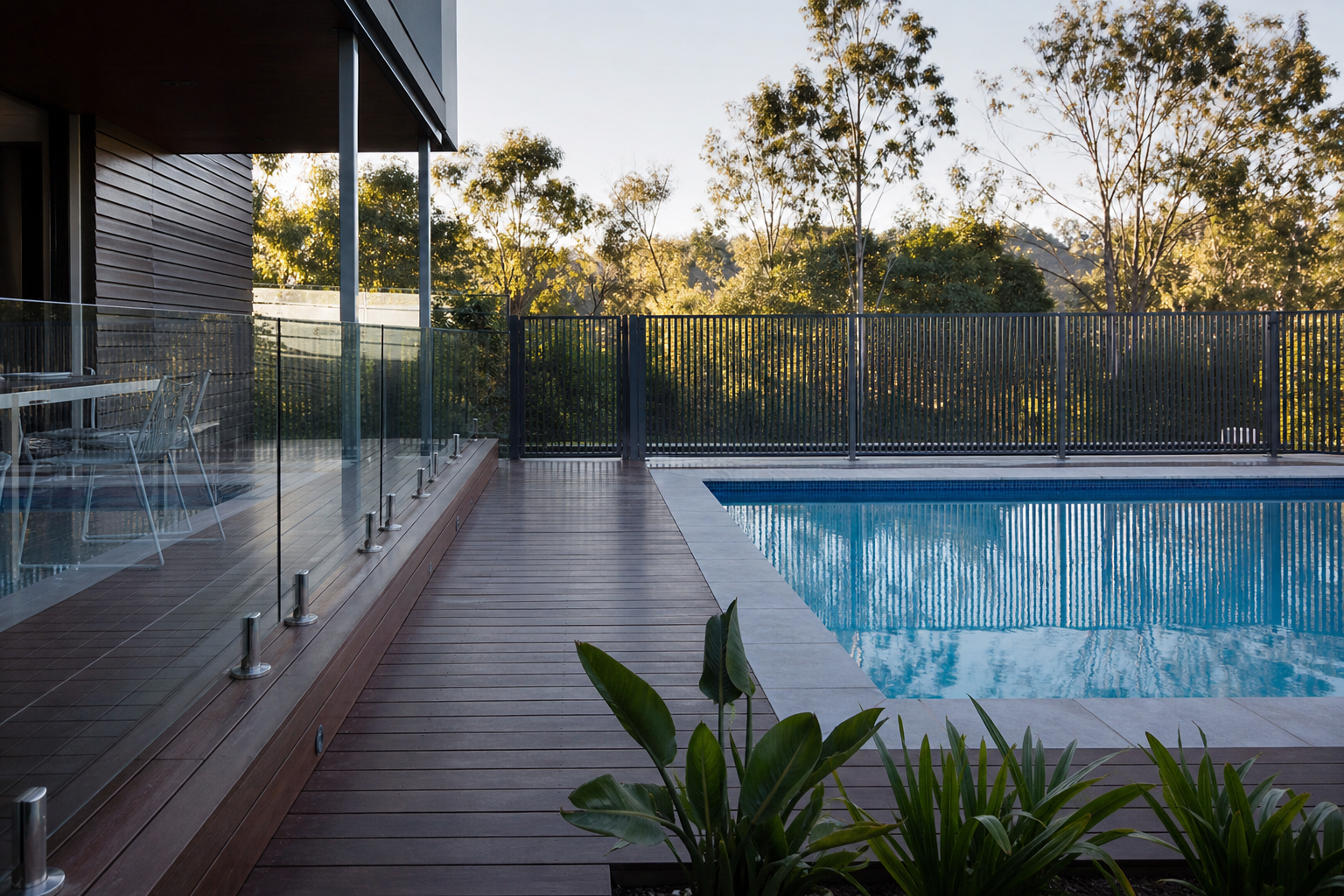
Aluminium Fencing & Balustrade Systems
TS Aluminium fabricates heavy-duty pool fencing, boundary slat panels, and glass balustrades. Sourced from 6063-T6 architectural grade aluminium, our fence systems meet structural safety codes.
Screw Flange Slat Configuration
Unlike standard fences made of thin snap-in slats that rattle and loosen over time, our fencing panels use a heavy screw-flange design. Slats are secured directly to the post frame using stainless steel screws in integrated screw ports. This structure guarantees strength and eliminates rattling under high wind pressures.
"By utilizing Class 2 super-durable powder-coat treatments in our workshop, our fencing slats resist weathering and chalking from salt spray and high UV exposure."
Balustrade Safety Codes Compliance
Our balustrades and pool fences are engineered to meet safety standards:
- AS 1926.1 (Pool Safety): Slat gaps are restricted to less than 100mm to prevent child access, and gate hinges use self-closing spring mechanisms.
- Load Resistance: Top rail balustrades are rated to withstand at least 0.75 kN/m point loads, meeting structural requirements.
- Alloy selection: Sourced from 6063-T6 alloy for durability and corrosion resistance.
Frequently Asked Questions
Are your pool fences compliant with AS 1926.1?
Yes, all our pool safety fencing designs and locking latches strictly comply with AS 1926.1-2012 safety standards, guaranteeing child safety.
What is the maximum post spacing for balustrades?
For structural stability, our balustrade systems require post spacing of no more than 1500mm under standard residential loadings.
Do you offer custom powder coating colors?
Yes, we apply a wide selection of Dulux architectural powder coat finishes in-house in compliance with AS 3715.
Related Projects & Case Studies
Cleveland Waterfront Pool Safety Fencing
Compliant pool fencing finished in satin black powder coat with magnetic safety gate latch mechanisms.
Springfield Residential Balustrade Assembly
Structural aluminium balustrades with vertical slats assembled on a raised residential deck.
Request Engineering Specification
Submit your project dimensions, wind zone parameters, or target specs. Our Slacks Creek team will review and reply within 24 hours.
Engineering Analysis & Deflection Limit Calculations
TS Aluminium designs and processes all architectural and industrial systems to strict mechanical deflection limits. For clear-span structures, such as patio rafters and carport frames, the deflection is calculated under combinations of dead loads and dynamic wind pressures. The structural deflection limit is restricted to L/180 (span divided by 180) or 15mm maximum deflection under design load combinations. The elastic deflection is governed by the moment of inertia (Ix) of the profile section and the modulus of elasticity (E) of the alloy. For structural aluminium, E is taken as 70,000 MPa, as defined in AS/NZS 1664.1:1997 (Aluminium structures - Limit state design).
For example, the deflection of a simply supported rafter beam under a uniform load is calculated using the elastic formula:
deflection = (5 * w * L^4) / (384 * E * Ix)
Where 'w' represents the design load combination (including Region B wind uplift pressures), 'L' represents the clear span in millimeters, and 'Ix' represents the moment of inertia about the bending axis. For a 200mm x 50mm fluted rafter, Ix registers at 85.8 cm4, providing the stiffness needed to support spans up to 5.0 meters under N4 wind classifications.
For T-slot profiles used in machinery frames, stiffness is calculated to ensure linear rail alignment under static loads. Our modular frames feature structural alloys like 6005-T5, which offer high mechanical limits. By matching the moment of inertia tables with the dynamic load cycle limits of your equipment, our engineers select the correct T-slot profiles (TS 3030, TS 4040, or TS 8080) to prevent structural vibrations and extend tool lifespans.