Louver Adjustable Sunshade Roof Systems
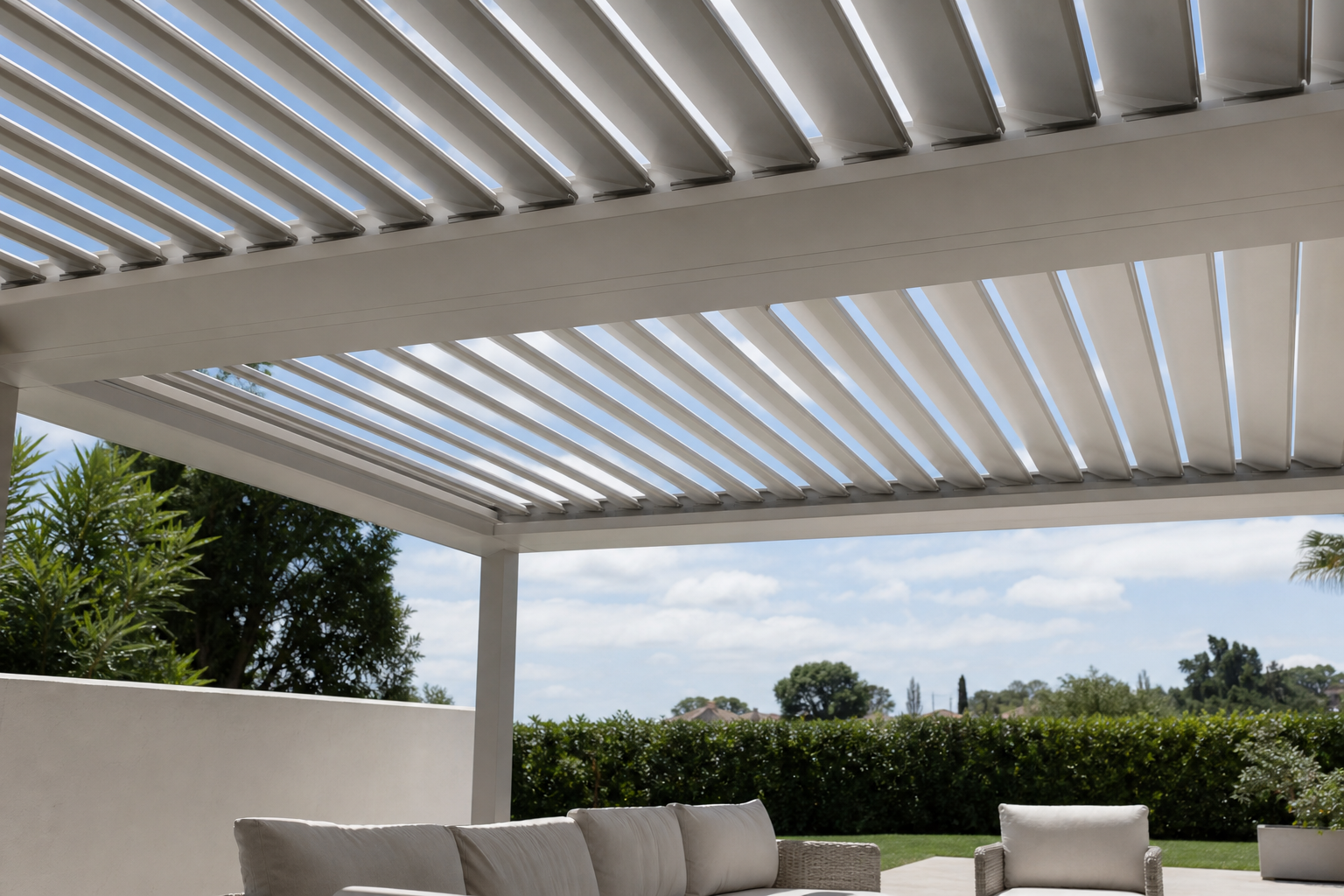
TS Aluminium adjustable louver roof systems combine dynamic sun shading with total rain sealing. Engineered with 6063-T6 architectural grade frames and custom-milled rotating gears, our louvers rotate up to 150 degrees to track the sun.
Aerofoil Blade Profile Geometry
Our louvers feature an aerofoil blade cross-section. The hollow design increases the profile's moment of inertia, preventing warping over spans up to 4.5 meters. When closed, co-extruded EPDM rubber weather gaskets compress together, creating a watertight seal that channels rainwater into hidden internal gutter beams.
"By utilizing premium Somfy tracking motors and M8 stainless steel rotating pins, our adjustable louver slat setups operate smoothly and maintain sealing alignment over decades of wind-load vibration cycles."
Louver Blade Technical Specifications
Louvers are processed inside our Slacks Creek workshop to strict tolerances:
| Specification Parameter | Target Rating Value |
|---|---|
| Alloy Grade & Temper | 6063-T6 (Architectural Grade) |
| Blade Profile Width | 200mm / 150mm options |
| Rotation Arc Range | 0 to 150 Degrees |
| EPDM Gasket Tensile Limit | >12 MPa (AS 1646 compliant) |
| Anodized Thickness Class | AA15 (Standard) / AA25 (Coastal Marine) |
Frequently Asked Questions
What is the maximum rotation angle of the aerofoil blades?
Our louver blades rotate up to 135 degrees. This allows precision control over ambient sunlight levels, passive ventilation, and rain protection.
How are the electric actuators protected against severe Brisbane storms?
We use IP67 rated linear actuator motors housed inside sealed structural cavity channels, protecting them from dust and high-pressure water streams.
Can the louver roofs integrate with rain sensors?
Yes, our control boxes feature automated rain sensor modules that trigger automatic closure within 3 seconds of moisture detection.
Related Projects & Case Studies
Brisbane CBD Commercial Louver Installation
Automated louver system with dual aerofoil blade profiles integrated into a commercial rooftop restaurant dining area.
Southport Waterfront Louver Roof
Dual actuator zones louver canopy finished in marine-grade clear anodized coating (25 microns) for corrosion resistance.
Request Engineering Specification
Submit your project dimensions, wind zone parameters, or target specs. Our Slacks Creek team will review and reply within 24 hours.
Engineering Analysis & Deflection Limit Calculations
TS Aluminium designs and processes all architectural and industrial systems to strict mechanical deflection limits. For clear-span structures, such as patio rafters and carport frames, the deflection is calculated under combinations of dead loads and dynamic wind pressures. The structural deflection limit is restricted to L/180 (span divided by 180) or 15mm maximum deflection under design load combinations. The elastic deflection is governed by the moment of inertia (Ix) of the profile section and the modulus of elasticity (E) of the alloy. For structural aluminium, E is taken as 70,000 MPa, as defined in AS/NZS 1664.1:1997 (Aluminium structures - Limit state design).
For example, the deflection of a simply supported rafter beam under a uniform load is calculated using the elastic formula:
deflection = (5 * w * L^4) / (384 * E * Ix)
Where 'w' represents the design load combination (including Region B wind uplift pressures), 'L' represents the clear span in millimeters, and 'Ix' represents the moment of inertia about the bending axis. For a 200mm x 50mm fluted rafter, Ix registers at 85.8 cm4, providing the stiffness needed to support spans up to 5.0 meters under N4 wind classifications.
For T-slot profiles used in machinery frames, stiffness is calculated to ensure linear rail alignment under static loads. Our modular frames feature structural alloys like 6005-T5, which offer high mechanical limits. By matching the moment of inertia tables with the dynamic load cycle limits of your equipment, our engineers select the correct T-slot profiles (TS 3030, TS 4040, or TS 8080) to prevent structural vibrations and extend tool lifespans.